
The Summer Week When the Sky Goes the Wrong Colour
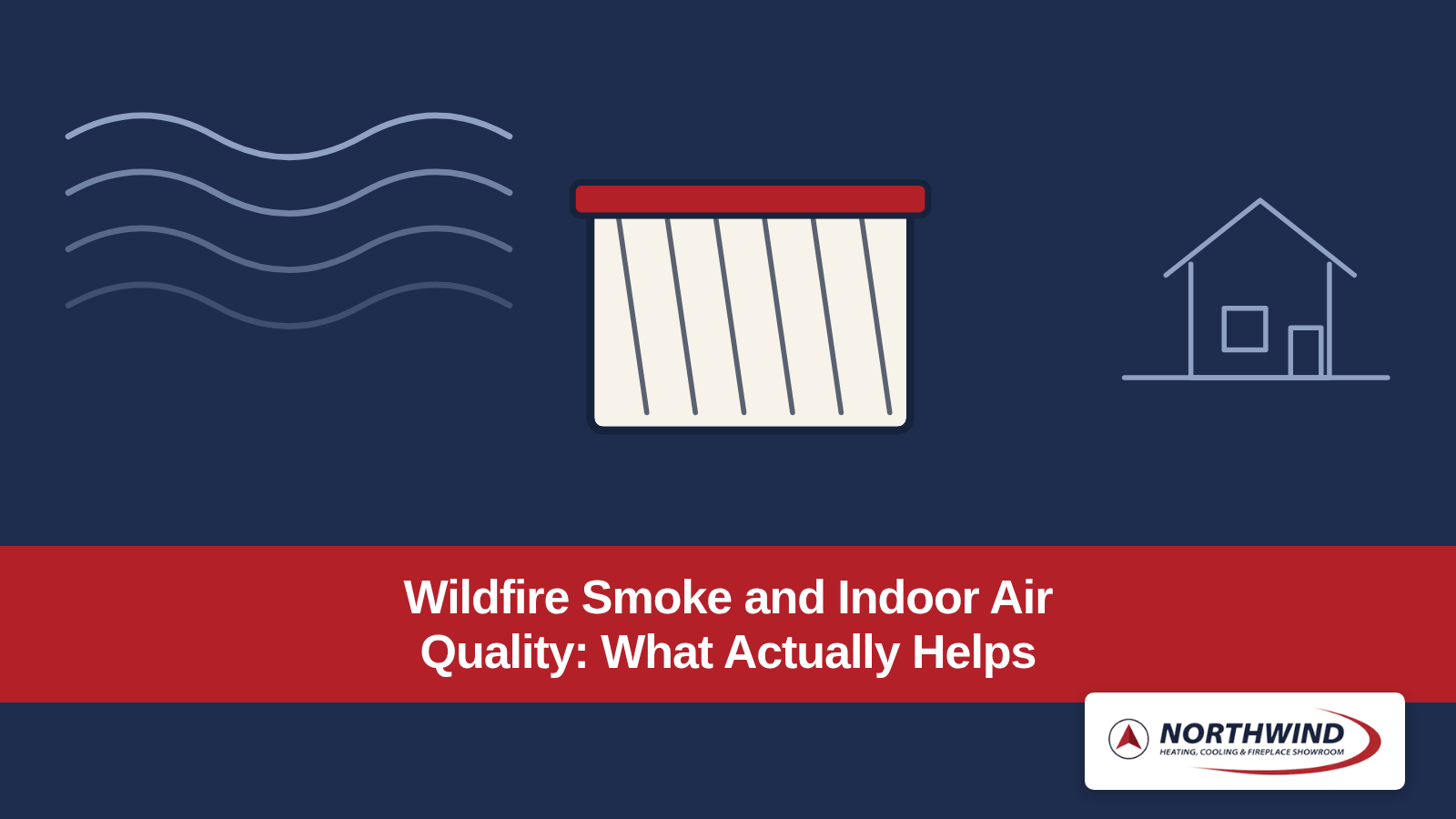
If you are researching Wildfire Smoke and Indoor Air Quality: What Actually Helps, you are probably doing it ahead of a smoke event rather than during one, which is the sensible order. Once an advisory is issued, the good filters are back-ordered and the portable units left on the shelf are the ones nobody wanted.
Summer smoke is now a recurring feature of life in Surrey, Langley, Delta and White Rock rather than an unusual event. It does not arrive on a schedule, but it arrives often enough that treating it as a surprise no longer makes sense.
Some responses help a great deal, several do very little, and a few make things worse by starving the equipment you rely on for cooling. What follows is how our team at Northwind Heating, Cooling & Fireplace Showroom thinks about it, including where the honest answer is a compromise. If anyone in the house has respiratory sensitivity, follow the guidance issued by your public health authority — that side of it is theirs to advise on, not ours.
What You Are Actually Trying to Filter
The particles are very small
Wildfire smoke is mostly fine particulate, far below the size of anything visible as a single speck. It behaves less like household dust and more like a gas: it follows air currents, it does not settle quickly, and it passes through gaps that stop ordinary dust easily.
Your house leaks more than it feels like it does
Homes built here between the 1960s and 1990s exchange a meaningful share of their indoor air with outdoors every hour without a window being opened. The paths are unglamorous: rim joists, attic hatches, exhaust ducts, worn door sweeps and older aluminium-framed windows.
The Furnace Filter Question, Answered Honestly
A standard filter catches very little smoke
The thin fibreglass panel most systems ship with exists to protect the blower and the indoor coil from lint and hair. It was never designed for fine particulate. If your plan for smoke season is a fresh filter of the type you already use, the plan does almost nothing.
Higher ratings work, within limits
Filters in the MERV 13 range and above capture a useful proportion of fine particulate, but capturing more means resisting airflow more, and forced-air systems are built around a narrow band of static pressure. A dense filter in a one-inch slot shows up as reduced airflow, longer run times and strain on the blower. We have written separately about choosing a MERV rating for a Lower Mainland home.
The filter your system tolerates may not be the one that helps most
Plenty of systems here cannot accept a filter dense enough to matter. Forcing one in does not produce clean air — it produces a restricted system with air bypassing around the filter edges. If a technician says your equipment will not take a MERV 13 in a one-inch slot, the answer lies somewhere other than the furnace.
Fan Settings, Recirculation and Sealing
Continuous fan helps only with an adequate filter
Running the fan continuously is common advice and it is half right. A fan running all the time passes house air through the filter repeatedly rather than only on a call for heating or cooling. Through a filter that does not capture smoke, it simply distributes smoke more evenly.
Recirculate rather than draw in outside air
During a smoke event you want indoor air moving in a loop, not replacement air pulled from outside. Most residential forced-air systems recirculate by default. The exceptions worth checking are a fresh-air intake ducted into the return, a whole-house fan, and any ventilation appliance running on a timer.
Seal the obvious leaks, ignore the exotic ones
Full air sealing is not a smoke-season project, but the largest gaps are worth an hour.
• Windows and patio doors. Latch them rather than simply closing them, which pulls the sash tight against the weatherstripping.
• Door sweeps. A worn sweep is often the largest single opening in a house, and a replacement is inexpensive.
• Exhaust fans. Bathroom and range hood fans push air out, drawing unfiltered outdoor air in to replace it.
• Attic hatches. These open onto a space that is not sealed from outdoors, and one can be weatherstripped in an afternoon.
Portable HEPA Units in the Rooms You Use
Size the unit to a room, not to the house
A true HEPA unit is genuinely effective against fine particulate and is often the best purchase of the season. The common mistake is buying one for a whole house. Portable units are rated for a floor area, and their effect falls off sharply beyond the room they sit in.
Bedrooms first
You spend roughly a third of your time in one room with the door shut, which makes the bedroom the easiest space to keep meaningfully cleaner than the rest of the house. This approach is often more effective than forcing an unsuitable filter into a furnace that cannot breathe through it.
Avoid anything that produces ozone
Some devices marketed for smoke and odour work by generating ozone or charged particles. Ozone is an irritant in its own right and does not belong in occupied rooms. If a product emphasises what it emits rather than what it captures, it is the wrong category of device.
Whole-Home Air Cleaners and Ductless Heads
Deep media cabinets
Where a house has ducted heating or cooling and there is room at the furnace, replacing a one-inch slot with a four- or five-inch media cabinet is usually the most durable improvement available. The added surface area allows a high-efficiency medium without the pressure penalty.
Electronic and in-duct cleaners
Beyond media filtration there are electronic cleaners, polarised-media units and various in-duct devices, and their usefulness varies by type and by maintenance. Some need their collector cells washed regularly to work at all. We fit and service a range of indoor air quality equipment, and the first question is always what airflow the system actually has.
Ductless systems have their own filters
Ductless heads are easy to overlook because their filters sit behind a panel that is rarely opened. The washable screens are coarse by design, but they clog quickly in smoky conditions, and a clogged screen costs capacity during a heat event. Our comparison of ductless and central systems for townhouses covers the trade-off: ductless cools well but offers no central filtration.
Where HRV and ERV Ventilation Complicates Things
A ventilator does the opposite of what you want that week
Heat recovery and energy recovery ventilators bring in outdoor air continuously while reclaiming heat from the air they exhaust. In our climate they are valuable, particularly in tighter newer homes and strata buildings. During a smoke event, though, a ventilator on its normal schedule brings smoke indoors.
Recirculation mode, or off, then back on
Many units have a recirculation setting, some have a filter option better suited to particulate, and some have neither. Check which yours is before smoke season, because the control is often a small unlabelled button in a laundry room. Leaving ventilation off long after the smoke clears is the common mistake.
Frequently Asked Questions
Does a furnace filter help with wildfire smoke?
A standard furnace filter captures very little wildfire smoke, because smoke particulate is far finer than the lint and hair ordinary filters are built to catch. A filter in the MERV 13 range or above does capture a useful share, but only if the system can move air through it without excessive pressure drop. A deeper media cabinet is the proper fix.
Should I run my furnace fan during a wildfire smoke event?
Running the system fan continuously helps only if the filter in the system can capture fine particulate. With an adequate filter, continuous operation passes house air through it far more often and makes a real difference. With a standard filter it simply distributes smoke around the house.
What MERV rating do I need for wildfire smoke?
MERV 13 is the usual starting point for meaningful fine particulate capture, with higher ratings performing better still. Whether your system can accommodate it depends on the depth of the filter housing, the blower type and the existing static pressure. A five-inch media cabinet handles it comfortably; a thin slot on an older furnace often does not.
Are portable air purifiers better than upgrading my furnace filter?
For most homes, a correctly sized portable HEPA unit in the rooms you actually occupy removes more smoke from the air you breathe than an aggressive furnace filter upgrade does. Portable units concentrate their capacity in one room, while a central system is limited by what the blower can push. Where a system cannot take a better filter, portable units are the answer.
Should I turn off my HRV when it is smoky outside?
An HRV or ERV should be switched to recirculation mode or turned off while heavy smoke persists, because its normal function is to draw outdoor air into the house. Check before smoke season which mode your unit offers, as the control is often unmarked. Turn it back on once the air clears.
Does air conditioning bring wildfire smoke into the house?
A standard central air conditioner or heat pump recirculates indoor air and does not bring outdoor air inside, so running it during a smoke event is fine and usually advisable. The outdoor unit exchanges heat, not air. The exceptions are fresh-air intakes ducted into the return, whole-house fans and portable units vented through a window.
Doing This in May Rather Than in August
Nearly everything described here is cheaper and less rushed when arranged before the first advisory of the season. A media cabinet is a scheduled morning of work in spring and an unavailable part in August.
No practical measure removes all smoke from a house, and there is no single purchase that solves it. There is a filter that suits your equipment, a fan setting that matches it, a ventilator that needs a decision made in advance, and one or two rooms worth protecting properly.
Northwind Heating, Cooling & Fireplace Showroom has been installing and servicing heating, cooling, heat pumps, ductless systems, fireplaces, water heaters, outdoor heating and indoor air quality equipment across Surrey, Langley, Delta, White Rock and the wider Lower Mainland since 1989, and we are a registered CleanBC contractor. Smoke planning sits alongside the rest of our HVAC installation and service work. If you would like to know what filtration your system can realistically carry before the smoke arrives, Get in touch and we will look at the equipment you have rather than the equipment a brochure assumes you have.
Other Blog Posts
Customer Testimonials
Go With Experience

I cannot recommend this company enough. We were horribly jerked around by Angels Heating and Cooling. Northwind took the time to answer all our questions, we're professional, timely, affordable and sent a great technician to fix our gas fireplace.
We had a duel fuel system installed by Northwind. Our experience from installation to post installation service has been amazing.
Our fireplace had not been working. This was the only company that was willing to come out. Wes the technician was great. Diagnosed the problem and fixed it. Spoke to Deanna on the phone. She has awesome customer service skills. I would use them again and highly recommend them.
A+ Customer Service! We had a minor issue and they stopped by right away. We've used them on residential and commercial buildings and they are always on top of everything. Thank you to Chris as well!
We purchased and had Nothwind install a Valor gas fireplace for us. They did an excellent job. We did have a problem with the remote control that came with the unit but were very happy with the immediate response and repair from Northwind for warranty work.
I’ve been in the construction business for many years and the Northwind HVAC crew for sure rank up there in the number one spot. Without exception, all the work was carried out swftly, with journeyman style and with a friendly contractor/client relationship.
Home
Blogs