
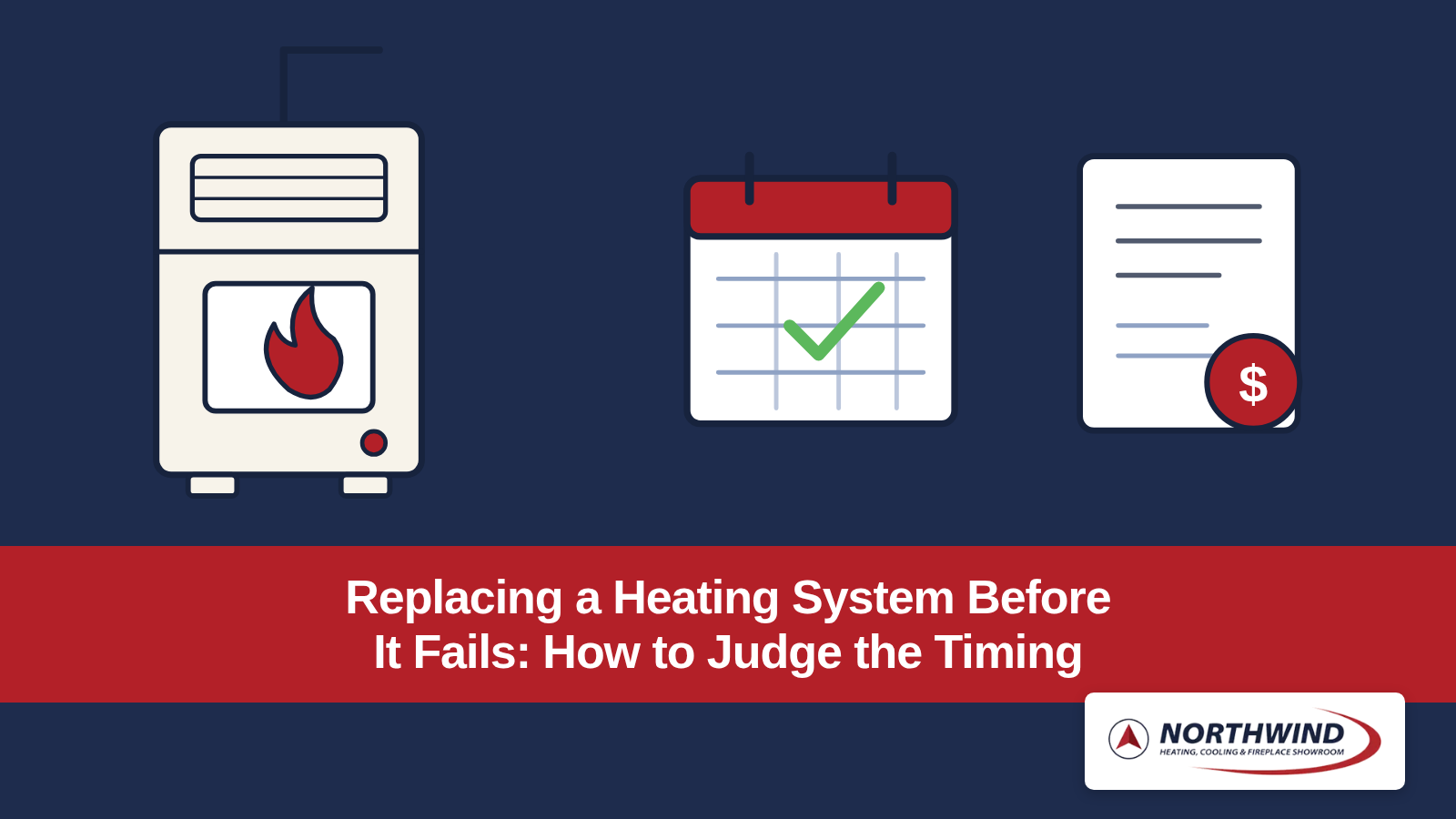
The Question That Always Arrives in September
If you are researching Replacing a Heating System Before It Fails: How to Judge the Timing, you are almost certainly not standing in a cold house with a dead furnace. You are more likely in a comfortable one, in early autumn, thinking about the system that made an unfamiliar noise last February.
This post closes out a year of writing about heating and cooling in the Lower Mainland, and it is the question underneath most of the others. At some point equipment stops being worth keeping alive, and the only real decision is whether you choose the moment or the moment chooses you.
What follows is how our team at Northwind Heating, Cooling & Fireplace Showroom thinks about it after decades of doing this in Surrey, Langley, Delta and White Rock. There is no formula. There are service life bands, a few meaningful signals, and a strong argument that a planned replacement beats a forced one. Replacing a system that still works also costs real money, so the goal is not to replace as early as possible.
How Long This Equipment Actually Lasts
Service life is a band, not a number. Two identical furnaces installed the same week on the same street can end up years apart.
Gas furnaces
A gas furnace here typically has fifteen to twenty-five years of useful life in it, and well-maintained units often reach the upper end. Our mild winters help: less time at full output shows up as extra years. What shortens the band is a unit oversized at installation that has short-cycled ever since, or one that has gone a decade without a filter change.
Heat pumps and air conditioners
Heat pumps and central air conditioners generally sit lower, around twelve to twenty years, as do ductless systems. Heat pumps land at the lower end when they handle both heating and cooling, because they run more hours per year than a cooling-only machine. Coastal damp matters in a way it does not for a furnace: moisture, leaf litter and poor drainage around the outdoor unit all take a toll.
Why the range is the useful part
A thirteen-year-old furnace is not old, and a twenty-two-year-old one is not automatically finished. What the bands tell you is where on the curve you stand. Under the band, a fault is usually just a fault. Inside it, a fault is information. Past it, a fault is a fair warning.
The Signals That the End Is Genuinely Near
Age alone is weak evidence. Age plus any two of the following is much stronger, and worth acting on before the weather decides for you.
Repairs in consecutive seasons
One repair is an event. A repair last winter and another this winter is a pattern, and it usually means the components around the failed part are the same age as it. Anything that needed a service call in the coldest stretch of last season deserves attention now, because the same load returns in about eight weeks.
Parts becoming hard to source
When a control board, an inducer motor or a gas valve for your model takes days to find rather than hours, a mid-winter breakdown is no longer a one-day inconvenience. Manufacturers do not support models forever, and once supply thins out every future repair carries a wait attached to it. Ask your technician whether parts for your unit are still readily available.
Bills rising with no change in habits
If your energy use has crept up over two or three years while household size, thermostat settings and routines have stayed the same, the equipment is likely working harder for the same result. Compare full seasons rather than single months.
Uneven heating that was not there before
Rooms that were fine five years ago and are now noticeably cooler point at declining capacity or airflow. In homes built between the 1960s and the 1990s this is sometimes a duct problem rather than an equipment problem, which is worth ruling out first. When the rest of the picture suggests an ageing system, new unevenness usually belongs to the same story.
Repair or Replace, Without Pretending There Is a Formula
Several rules of thumb circulate for this decision, most of which multiply an age by a repair cost. They are less precise than they look, and they turn a judgement call into false arithmetic.
The parts that are real
Three things are worth weighing. First, the repair in front of you against the remaining life it buys — one more winter out of a twenty-year-old furnace is a different proposition from five years added to a twelve-year-old one. Second, what your running costs would look like on new equipment, which now means genuinely comparing heat pumps and gas furnaces rather than defaulting to a like-for-like swap. Third, the odds that this repair is the first of several.
What replacing too early costs
We should be plain about this. Replacing a working system means paying for equipment you did not yet need and discarding service you had already bought, which is a real cost rather than a rounding error. A well-maintained furnace at seventeen years with no repair history and no symptoms is not a problem to be solved. The argument here is not that earlier is better; it is that on your terms is better.
Why a Planned Replacement Is a Better Purchase
The difference between a planned replacement and an emergency one is not mainly about money. It is about how many of the decisions you make yourself.
You choose the equipment
In an emergency your choice narrows to what can be installed within days — whatever sits in a Lower Mainland warehouse in roughly the right capacity. Planned, you can consider what the house actually needs, whether a heat pump suits your layout and electrical service, and have a proper load calculation done instead of a same-size swap.
You choose the installer and the timing
Installation quality matters more than brand, and good installers are booked further ahead in December than in April. We have described what an emergency replacement actually looks like hour by hour, and that compressed timeline is this argument in miniature: same house, same equipment, but every decision made under pressure.
Why Spring and Early Autumn Are the Right Windows
What the shoulder seasons buy you
April into early June, and September into October, are the quiet windows. Scheduling is easier, lead times are shorter, and a changeover happens in a house sitting comfortably at 15 to 18 degrees with nothing running. A second visit to finish properly is then an inconvenience rather than an emergency.
Planning around this month
September is the last unhurried window before the heating season, which makes it a good month to book an inspection and ask directly about remaining life. If you have several good years left, you have lost nothing. If you are on borrowed time, you have found out now rather than in January.
Rebates and Financing Are Easier with Time in Hand
Rebates take paperwork and sequence
Rebate programmes set conditions about what is installed, who installs it and what documentation is submitted, and several require steps before the work rather than after. None of that is difficult with a few weeks in hand; all of it is difficult on the day your furnace fails. If you are weighing electrification, read up on the BC rebates available to Lower Mainland homeowners and check your eligibility early. Northwind is a registered CleanBC contractor, which matters for some programmes.
Financing deserves more than an afternoon
The same applies to how you pay. Comparing financing options is a reasonable way to spend a weekend and an unreasonable thing to do in a utility room while somebody waits for an answer.
Frequently Asked Questions
How long does a furnace last before it needs replacing?
Most gas furnaces last between fifteen and twenty-five years, with well-maintained units in our mild coastal climate often reaching the upper part of that range. Sizing and installation quality affect the number more than brand does, since an oversized furnace that short-cycles wears out sooner. Age alone is not a reason to replace, but past about fifteen years it changes how you read every fault.
Should I replace my furnace before it breaks?
Replacing before failure makes sense when the system is inside or beyond its service life band and showing another real signal, such as repairs in consecutive seasons or rising bills with no change in habits. If it is well inside its expected life, has no repair history and heats evenly, there is no good reason to replace it early. The aim is to replace on your own schedule, not as soon as possible.
What is the best time of year to replace a heating system?
Spring and early autumn are the best windows, because scheduling is easier, lead times are shorter, and the house stays comfortable during the changeover with nothing running. In the Lower Mainland that means roughly April to early June, and September into October. Mid-winter replacements are possible, but everything about them is harder.
Is it worth repairing an old furnace or should I just replace it?
Repair is usually worth it when the fault is isolated, parts are readily available, and the system otherwise runs evenly for its age. It becomes hard to justify when the repair is substantial, the unit is at or past its service life band, and it already needed attention in a previous season. Ask the technician what is likely to fail next.
How do I know if my heat pump is failing?
The clearest signs are declining capacity, longer run times, rising electricity use with unchanged habits, and repeat service calls in consecutive seasons. Heat pumps generally last twelve to twenty years, and outdoor units in our damp coastal air corrode sooner when drainage and clearance around the base have been neglected. Ice that does not clear after a defrost cycle is worth investigating promptly.
Why is my heating bill going up when nothing has changed?
A steady multi-year rise in energy use with no change in household size, thermostat settings or routines usually means the equipment is working harder for the same result. Compare full seasons rather than single months, because one cold snap will distort any individual bill. Dirty filters, duct leakage and a failing thermostat are cheap to rule out first.
Deciding on Your Own Terms
The households happiest with their heating are rarely the ones who spent the most. They are the ones who decided in daylight, with options in front of them, rather than at seven in the morning in a house gone cold overnight.
You do not need to act today. What is worth doing is finding out where you stand — the age of the equipment, its repair history, whether parts are still easy to get — so that when the moment arrives you are choosing rather than reacting.
Northwind Heating, Cooling & Fireplace Showroom has been installing and servicing heating, cooling, heat pumps, ductless systems, fireplaces, water heaters, outdoor heating and indoor air quality equipment across Surrey, Langley, Delta, White Rock and the wider Lower Mainland since 1989, and we are a registered CleanBC contractor. If you would like an honest assessment of how much life your system has left, and what your options look like when you are not under pressure, Get in touch.
Other Blog Posts
Customer Testimonials
Go With Experience

I cannot recommend this company enough. We were horribly jerked around by Angels Heating and Cooling. Northwind took the time to answer all our questions, we're professional, timely, affordable and sent a great technician to fix our gas fireplace.
We had a duel fuel system installed by Northwind. Our experience from installation to post installation service has been amazing.
Our fireplace had not been working. This was the only company that was willing to come out. Wes the technician was great. Diagnosed the problem and fixed it. Spoke to Deanna on the phone. She has awesome customer service skills. I would use them again and highly recommend them.
A+ Customer Service! We had a minor issue and they stopped by right away. We've used them on residential and commercial buildings and they are always on top of everything. Thank you to Chris as well!
We purchased and had Nothwind install a Valor gas fireplace for us. They did an excellent job. We did have a problem with the remote control that came with the unit but were very happy with the immediate response and repair from Northwind for warranty work.
I’ve been in the construction business for many years and the Northwind HVAC crew for sure rank up there in the number one spot. Without exception, all the work was carried out swftly, with journeyman style and with a friendly contractor/client relationship.
Home
Blogs