
Guide
HVAC Repair Guide: Recognizing When Your System Needs Professional Help
Why do heat pumps struggle in heavy rain? See what a true seasonal home maintenance checklist requires for damp winters and when to call a professional.
Is Your Heating System Ready for the Damp Winter Ahead?
As fall transitions into winter, many homeowners start looking for a reliable seasonal home maintenance checklist to ensure their property is prepared for the shifting weather. Are you noticing a persistent chill or a lingering dampness in your living space that a simple thermostat adjustment cannot fix? At Northwind Heating, Cooling & Fireplace Showroom, our team knows that across Surrey BC and the Lower Mainland, the transition to winter brings a unique set of challenges characterized by heavy rain and pervasive moisture. You face an important choice: relying on a basic, do-it-yourself filter change and hoping for the best, or scheduling a comprehensive seasonal preparation that addresses the specific vulnerabilities of your equipment. Taking proactive steps now prevents unexpected breakdowns during the coldest, wettest months of the year, ensuring your home remains a comfortable refuge from the elements.
For expert assistance with your seasonal preparation, explore our comprehensive HVAC services or learn more about upgrading your heating systems today.
Why Do Wet Climates Put Extra Stress on HVAC Equipment?
Generic dry-cold climate advice often fails to address the realities of our local weather patterns. In our years of servicing Surrey homes, we consistently see why heavy rain and damp winters force your equipment to work significantly harder.
The Impact of Extreme Moisture
During the Pacific Northwest atmospheric river season (November-February), our technicians regularly see heating systems face an uphill battle against extreme ambient moisture. When the air outside is saturated, outdoor units are subjected to constant water exposure. This heavy rainfall can infiltrate poorly sealed cabinets, accelerate wear on moving parts, and force the system to run longer cycles just to achieve the desired indoor temperature. The sheer volume of water requires excellent drainage and robust equipment protection to prevent premature failure.
Managing Indoor Humidity and Damp Drafts
Raw heating power is only one part of the comfort equation in a wet climate. Managing indoor humidity is equally critical. When damp outdoor air seeps into your home through drafts, it makes the indoor environment feel much colder than the thermostat indicates. Your heating equipment must expend additional energy to remove this moisture from the air before it can effectively raise the ambient temperature. If your system is struggling with humidity control, you will likely notice condensation on windows and a lingering, uncomfortable chill in the air.
Outdoor Unit Efficiency During Prolonged Rain
Prolonged wet conditions heavily impact the efficiency of outdoor components. Heat pumps, in particular, rely on unobstructed airflow to extract heat from the outside air. When heavy rain saturates the surrounding environment, and especially if leaves or debris accumulate around the base of the unit, that vital airflow is choked off. The system then draws more electrical current to compensate, driving up your energy consumption and putting unnecessary strain on the compressor.
What Are the Warning Signs You Need Immediate HVAC Repair?
Recognizing the symptoms of a failing system before it turns into a complete breakdown saves time, stress, and discomfort. Ignoring these early warning signs often leads to weekend emergencies when the system finally quits under heavy load.
• Inconsistent temperatures: If one room feels like a sauna while another feels like an icebox, your system is failing to distribute air evenly, pointing to ductwork issues or a failing blower motor.
• Short cycling: When your furnace or heat pump turns on and off rapidly without ever reaching the set temperature, it is a clear indicator of an underlying mechanical issue or a severely restricted airflow problem.
• Unusual operational noises: A sudden grinding, banging, or squealing sound is never normal. For example, if you notice your HVAC system making whistling sound, it typically indicates restricted airflow, a clogged filter, or a ductwork leak that requires immediate attention.
• Spikes in energy consumption: If your utility bills suddenly jump without a corresponding change in weather or usage habits, your equipment is working harder than it should to produce the same amount of heat.
Quick, professional response times are essential when these symptoms escalate. One local Surrey homeowner we recently helped experienced a complete furnace failure over a fall weekend, leaving their house rapidly dropping in temperature. By reaching out immediately, a service call was scheduled for the same afternoon. Our technician diagnosed the fault and completed the repair, ensuring the furnace was working like new by late afternoon, completely avoiding a freezing weekend.
How Does Heavy Rain Affect Heat Pump Defrost Cycles?
A defrost cycle is an automated, built-in process that allows your heat pump to melt away frost and ice that accumulates on the outdoor coil during cold weather operation. Because heat pumps extract heat from the outside air, the refrigerant inside the outdoor coil drops to very low temperatures. In damp climates, the moisture in the air condenses and freezes on this cold coil. The defrost cycle temporarily reverses the system's operation, sending warm refrigerant back to the outdoor unit to melt the ice, ensuring the system can continue to breathe and operate efficiently.
However, excessive rain and poor drainage complicate this process significantly. During the atmospheric river season, water can pool around the base of the unit. If this pooled water does not drain away quickly, the defrost cycle melts the ice, but the resulting water simply joins the puddle below. When temperatures drop overnight, that pooled water freezes solid, potentially encasing the bottom of the coil in a block of ice. This ice buildup physically damages the delicate aluminum fins on the coil and severely restricts the airflow necessary for heat transfer.
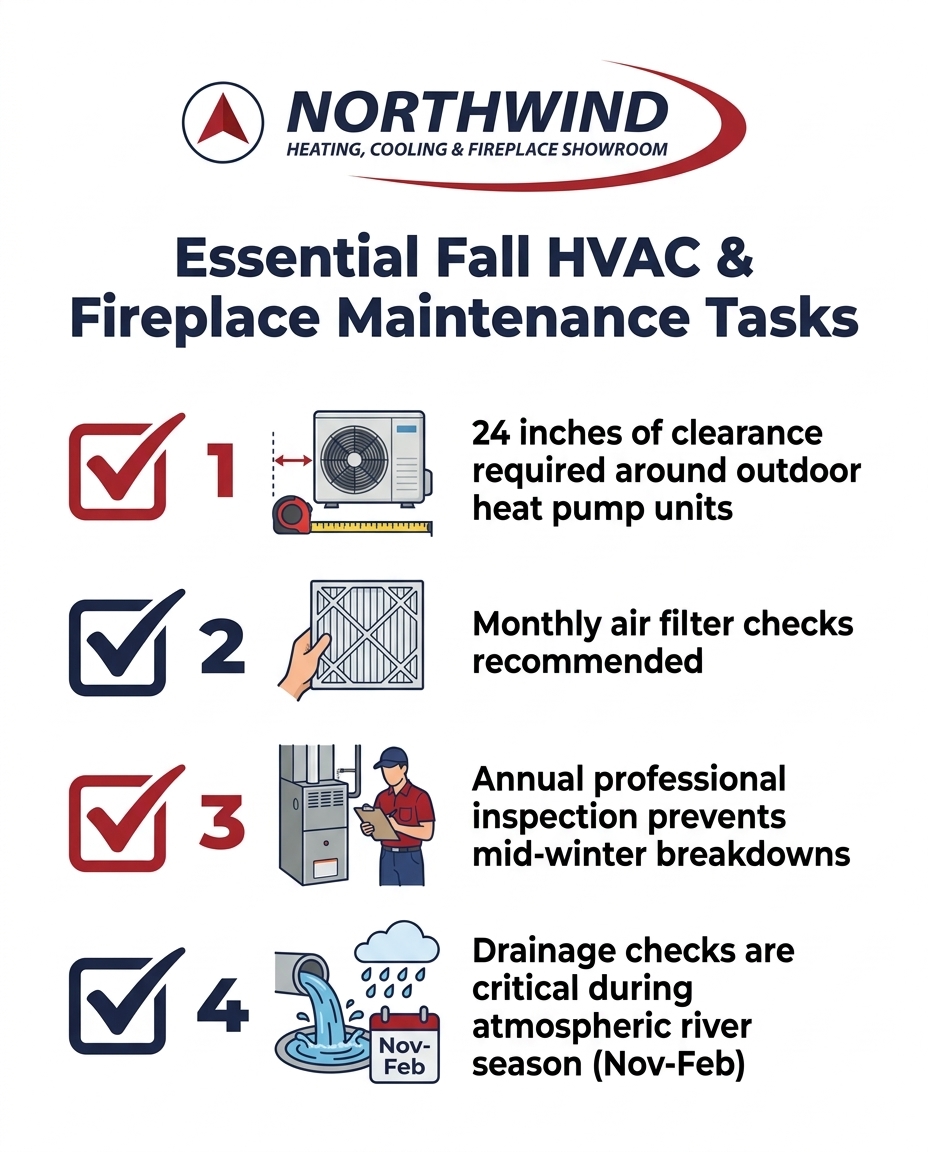
To combat this, our installation team always emphasizes the strict requirement for at least 24 inches of clearance around the outdoor unit. This clearance ensures that heavy rain can disperse, melting frost can drain away cleanly, and the unit has access to the massive volume of air it needs to function. If you rely on heat pump systems for your winter comfort, maintaining this clearance and verifying that the ground slopes away from the unit are non-negotiable steps for reliable operation.
Seasonal Maintenance: What Can You DIY vs. When to Call a Pro?
Understanding the boundary between safe homeowner upkeep and tasks that require a licensed professional is vital for your safety and the longevity of your equipment. Year-round systems require attention for both heating and cooling components to function optimally, but not all maintenance is created equal.
• Airflow & Filtration — Safe DIY Tasks for Homeowners: Changing air filters monthly; ensuring indoor vents are unblocked by furniture. — Requires a Licensed Professional: Internal blower motor cleaning; ductwork pressure testing and balancing.
• Outdoor Unit Care — Safe DIY Tasks for Homeowners: Clearing leaves, branches, and snow; maintaining 24 inches of clearance. — Requires a Licensed Professional: Chemical coil cleaning; straightening damaged aluminum fins.
• Electrical & Refrigerant — Safe DIY Tasks for Homeowners: Replacing thermostat batteries; resetting a tripped breaker once. — Requires a Licensed Professional: Testing capacitors; checking refrigerant levels; repairing wiring.
• Safety Systems — Safe DIY Tasks for Homeowners: Testing smoke and carbon monoxide detectors; replacing detector batteries. — Requires a Licensed Professional: Checking for gas leaks; testing furnace safety limit switches; inspecting heat exchangers.
Attempting professional-level repairs on your own carries severe risks. Our team frequently sees the costly aftermath of DIY mistakes, which is why we remind customers that handling refrigerant without specialized training and licensing is illegal and dangerous. Opening sealed electrical cabinets exposes you to high-voltage hazards. Furthermore, unauthorized DIY repairs on internal components will almost certainly void your manufacturer's warranty. If you suspect your system is struggling, whether it is a heating issue or you need air conditioning repair, it is always safer and more cost-effective in the long run to trust a certified technician.
Why is Comprehensive Professional Maintenance Essential?
A professional tune-up goes far beyond a simple visual inspection. It is a rigorous, multi-point evaluation designed to restore your equipment to factory specifications, maximize energy efficiency, and guarantee the safety of your household.
1. Testing safety controls and gas lines: For gas furnaces and fireplaces, a technician meticulously checks for potential gas leaks, inspects the venting system for proper drafting, and tests all internal safety switches. This ensures that if a malfunction occurs, the system will shut down safely rather than posing a hazard to your home.
2. Optimizing performance and airflow: Technicians measure the electrical draw of motors, test the capacitance of starting components, and evaluate the overall airflow through the ductwork. By calibrating the thermostat and tightening electrical connections, they ensure the system delivers consistent comfort without wasting energy.
3. Extending equipment lifespan: Routine servicing mitigates the wear and tear that accumulates over months of heavy use. A clean, well-lubricated system does not have to work as hard, which significantly extends the operational lifespan of the equipment and delays the need for a costly replacement.
4. Unlocking incentives: Professional maintenance and properly documented servicing can help systems qualify for general energy rebates or federal tax credits, making high-efficiency upgrades more accessible for homeowners. Be sure to verify current programs with your local utility provider.
A thorough check brings absolute peace of mind before the deep cold sets in. For example, our team recently worked with a local homeowner dealing with hot summer days and challenging winter heating requirements who needed a properly sized solution for their property. We sized and installed a variable capacity AC and matching variable speed furnace, carefully considering the home's existing ductwork limitations. Because the system was professionally tailored and maintained, the AC kept the house perfectly cool during the summer, and the furnace now provides reliable, even warmth throughout the winter.
Frequently Asked Questions About HVAC Repair and Seasonal Prep
How do I prepare my heat pump for winter?
Preparing your heat pump involves clearing away any debris, such as fallen leaves or overgrown vegetation, from the outdoor unit. You must ensure there is proper drainage away from the base so that heavy rain and melting frost do not pool and freeze around the coil. Finally, schedule a professional inspection to verify that the defrost controls are functioning correctly and that the refrigerant levels are precisely calibrated for winter operation.
What does HVAC seasonal maintenance include?
Seasonal maintenance is a comprehensive service that includes inspecting all electrical connections and verifying thermostat calibration for accurate temperature control. The technician will clean the indoor and outdoor coils, evaluate the blower motor, and check for proper airflow throughout the home. Additionally, it involves rigorous testing of all safety controls, inspecting heat exchangers, and checking for potential gas leaks in fossil fuel systems.
How do I get my fireplace ready for winter?
To prepare your fireplace, you should first have a professional inspect the venting and draft to ensure that combustion gases are safely directed outside. The technician will clean the glass, vacuum out dust or pet hair from the control compartment, and check the ignition system for reliable starting. They will also verify that the remote control and wall thermostat are communicating properly with the fireplace receiver.
What is a good home maintenance schedule?
A reliable home maintenance schedule starts with monthly air filter checks, replacing them as soon as they appear dirty or clogged. In the spring, you should schedule a comprehensive preparation and tune-up for your cooling systems before the summer heat arrives. In the early fall, before the first freeze hits, you should schedule a thorough inspection and tune-up for your heating systems and fireplaces to ensure they are ready for the winter load.
Why is drainage so important for outdoor units in wet climates?
Proper drainage prevents water from pooling around the base of the outdoor unit during heavy rainstorms. If water is allowed to pool, it can freeze solid during overnight temperature drops, which encases the bottom of the unit in ice. This ice buildup protects the coil from ice damage and maintains the necessary, unobstructed airflow required for efficient heat transfer.
Can I check my own refrigerant levels?
No, handling refrigerant requires specialized training, specialized gauges, and specific licensing. Improper handling of pressurized refrigerants is extremely dangerous, illegal, and can cause severe chemical burns or environmental damage. Always rely on a certified, licensed technician to diagnose, measure, or adjust any refrigerant issues within your cooling or heating system.
Schedule Your Seasonal Inspection with a Local Expert
Preparing your home for the wet, chilly season is about much more than just changing a filter and hoping for the best. It requires a proactive approach to drainage, airflow, and professional safety checks to ensure your equipment can handle the heavy workload. We invite you to visit our physical Northwind Heating, Cooling & Fireplace Showroom in Surrey to explore tangible solutions for your home comfort needs and receive trusted, transparent advice from our team. Do not wait for a weekend breakdown—take action now and schedule an inspection for your heating systems to guarantee a warm, reliable, and comfortable winter for your entire household.
Other Blog Posts
Customer Testimonials
Go With Experience

I cannot recommend this company enough. We were horribly jerked around by Angels Heating and Cooling. Northwind took the time to answer all our questions, we're professional, timely, affordable and sent a great technician to fix our gas fireplace.
We had a duel fuel system installed by Northwind. Our experience from installation to post installation service has been amazing.
Our fireplace had not been working. This was the only company that was willing to come out. Wes the technician was great. Diagnosed the problem and fixed it. Spoke to Deanna on the phone. She has awesome customer service skills. I would use them again and highly recommend them.
A+ Customer Service! We had a minor issue and they stopped by right away. We've used them on residential and commercial buildings and they are always on top of everything. Thank you to Chris as well!
We purchased and had Nothwind install a Valor gas fireplace for us. They did an excellent job. We did have a problem with the remote control that came with the unit but were very happy with the immediate response and repair from Northwind for warranty work.
I’ve been in the construction business for many years and the Northwind HVAC crew for sure rank up there in the number one spot. Without exception, all the work was carried out swftly, with journeyman style and with a friendly contractor/client relationship.
Home
Blogs