
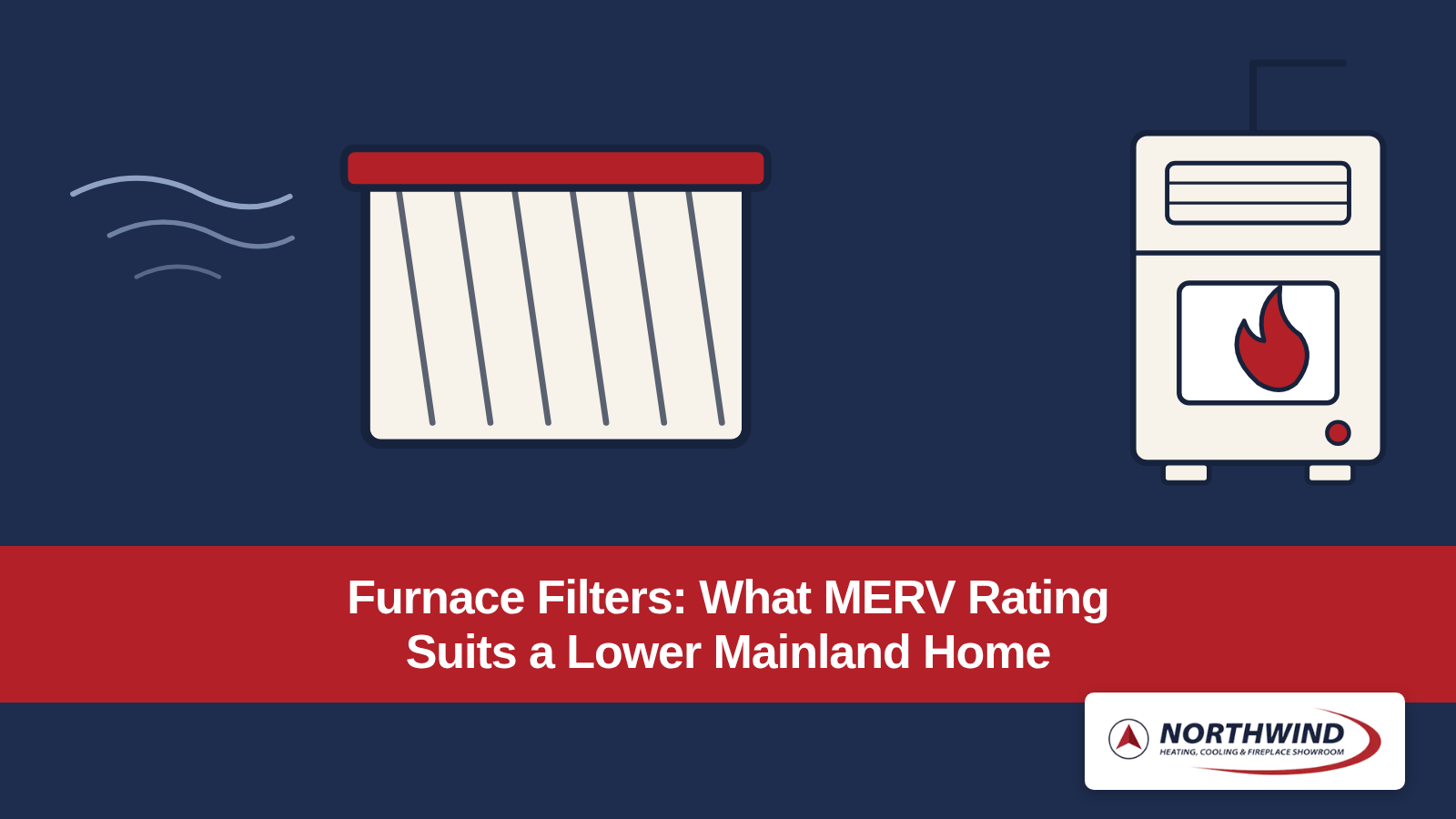
Furnace Filters: What MERV Rating Actually Suits a Lower Mainland Home
Higher MERV is not always better. What rating suits a Lower Mainland furnace, why filter thickness matters, and how to tell if yours is too restrictive.
The Aisle Where Everyone Guesses
If you are researching Furnace Filters: What MERV Rating Actually Suits a Lower Mainland Home, you have probably stood in front of a wall of filters with ratings from 5 to 16, packaging promising to capture everything down to viruses, and a price range of about five to one.
The instinct is to buy the highest number, on the reasonable assumption that more filtration is better. That instinct is wrong often enough to be worth writing about, and it is a conversation our team at Northwind Heating, Cooling & Fireplace Showroom has regularly.
The right filter depends on what your system can physically move air through. Get it wrong in the direction of "too good" and you can reduce comfort, raise your energy use and shorten the life of your equipment.
What MERV Actually Measures
MERV stands for Minimum Efficiency Reporting Value, and it describes how effectively a filter captures particles across a range of sizes. Higher numbers capture smaller particles more reliably.
• MERV 1–4 — the cheap spun fibreglass panels. These protect the equipment from large debris and do very little for air quality.
• MERV 5–8 — pleated filters capturing dust, pollen and mould spores. The standard residential range.
• MERV 9–12 — finer capture including much finer dust and some smoke particles. Good air quality improvement, and where most well-matched residential systems land.
• MERV 13–16 — capable of capturing very fine particles including a meaningful proportion of smoke. Genuinely effective, and genuinely restrictive.
The number tells you what the filter catches. It tells you nothing about whether your furnace can pull air through it, and that is the part that matters.
Why Higher Is Not Automatically Better
Filters create resistance
A finer filter has a denser medium, and a denser medium is harder to pull air through. That resistance is called static pressure, and every system has a limit to how much of it it can work against.
Exceed that limit and airflow through the whole system drops. The consequences are not subtle.
What restricted airflow actually does
• In heating, insufficient airflow across the heat exchanger causes it to overheat, and the limit switch shuts the furnace down. Repeated over years, heat exchanger life is shortened.
• In cooling, insufficient airflow across the evaporator coil can cause it to freeze, which stops cooling entirely and can damage the compressor.
• Everywhere, the blower works harder for less result, which uses more electricity and delivers less air to the rooms at the end of the longest duct runs.
That last point connects directly to a complaint we cover separately. A too-restrictive filter is a genuine contributor to cold rooms at the far end of the house.
Thickness matters as much as rating
This is the detail most homeowners miss. A four-inch or five-inch media filter has far more surface area than a one-inch filter of the same MERV rating, so air passes through it with much less resistance.
If your system has a one-inch filter slot, a MERV 13 filter in it is considerably more restrictive than a MERV 13 in a four-inch cabinet. The same number means something quite different depending on the housing.
What Actually Suits a Lower Mainland Home
Two local factors shape the answer here.
Our damp climate favours filtration
Mould spores and general dampness are more of a factor in coastal homes than in dry climates, which is an argument for filtration in the MERV 8 to 11 range rather than the cheapest fibreglass panel. Pleated filters in that band are a genuine improvement over the bare minimum without imposing much restriction. Filtration is only part of the damp-house picture, though — our post on winter condensation in coastal homes covers the ventilation side.
Wildfire smoke has changed the calculation
Summer smoke has become a recurring reality across the Lower Mainland, and it is the one situation where higher MERV ratings genuinely earn their keep. Smoke particles are extremely fine, and lower-rated filters do very little about them.
The tension is obvious: the filter that helps most during smoke season is the one most likely to restrict your system. The practical resolution is usually to establish what your system can tolerate, then run the highest rating within that limit — and if MERV 13 genuinely is not viable in your ductwork, address smoke with a dedicated air cleaner or a portable HEPA unit in the rooms that matter rather than by forcing an unsuitable filter into the furnace.
A reasonable default
For most Lower Mainland homes with a standard one-inch filter slot and ductwork of typical vintage, MERV 8 to 11 is the sensible band. It is a real improvement on fibreglass, it captures the dust, pollen and spores that matter day to day, and it does not usually push a system past what it can handle.
Going higher is worth doing when someone in the house has allergies or respiratory sensitivity, or when smoke season matters to you — but it should follow a check of what the system can take rather than a guess.
How to Tell If Your Filter Is Too Restrictive
You do not need instruments to spot the obvious cases.
• The furnace short cycles — firing, running briefly, shutting off and repeating.
• Airflow from registers feels noticeably weaker than it did with the previous filter.
• Rooms at the end of long runs got worse after you changed filter type.
• The evaporator coil freezes during cooling season.
• The blower is audibly louder or has a straining note to it.
• The filter looks sucked in or bowed toward the blower.
If you upgraded filters and any of these started, the filter is the first thing to change back. Short cycling in particular has several possible causes, which we cover in our post on a furnace that runs constantly.
How Often to Change It
Manufacturer intervals assume average conditions, and few homes are average. A one-inch pleated filter typically wants changing every two to three months, and thicker media filters every six to twelve.
Change more often if you have pets, if anyone in the house has allergies, during and after wildfire smoke, or if there has been construction or renovation nearby. The reliable method is not the calendar but holding it up to a light — if you cannot see light through it, it is doing more harm than good.
Worth checking in autumn before the heating season starts, since a filter left in place all summer is a classic cause of the failures we describe in our post on first cold night breakdowns.
Getting It Right Properly
If you want to know rather than estimate, a technician can measure static pressure across your system with the filter installed. That tells you definitively what your ductwork and blower can tolerate, and it is a quick check during an annual service.
It is also the honest answer to whether your home can run MERV 13. Some can. Many older systems with undersized returns cannot, and no amount of wanting it changes the physics. Where the answer is no and air quality matters to you, the better route is usually improving the filter cabinet or adding dedicated air cleaning rather than forcing the issue.
Filter choice matters most during smoke season, when the tension between capture and airflow is at its sharpest. Our guide to wildfire smoke and indoor air quality covers what genuinely helps.
Frequently Asked Questions
What MERV rating should I use in my furnace?
For most Lower Mainland homes with a standard one-inch filter slot, MERV 8 to 11 is the sensible range. It captures the dust, pollen and mould spores that matter in a damp coastal climate without restricting airflow enough to cause problems. Going higher is worth doing for allergies or smoke, but only after confirming your system can handle the additional resistance.
Is a higher MERV filter always better?
No. Higher MERV filters use denser media, which is harder to pull air through. If the resistance exceeds what your blower and ductwork can handle, airflow drops across the whole system — which can overheat the heat exchanger in winter, freeze the evaporator coil in summer, and starve the rooms furthest from the furnace. The right filter is the highest rating your system can actually move air through.
Can I use a MERV 13 filter in my home?
It depends on your ductwork and filter housing rather than on the furnace alone. A MERV 13 in a four-inch media cabinet has far more surface area and much less resistance than the same rating in a one-inch slot. A technician can measure static pressure across your system to give a definitive answer, which is worth doing before committing.
How often should I change my furnace filter?
Typically every two to three months for a one-inch pleated filter, and every six to twelve months for thicker media filters. Change more frequently with pets, allergies, or during wildfire smoke. Rather than relying on the calendar, hold it up to a light — if you cannot see light through it, replace it.
Will a better filter help with wildfire smoke?
Yes, because smoke particles are very fine and lower-rated filters capture little of them. Higher MERV ratings genuinely help. The complication is that those are also the most restrictive filters, so if your system cannot tolerate one, a dedicated air cleaner or a portable HEPA unit in the rooms you use most is a better answer than forcing an unsuitable filter into the furnace.
Can the wrong filter damage my furnace?
Over time, yes. A filter too restrictive for the system causes repeated overheating and limit switch shutdowns in heating, which shortens heat exchanger life, and can freeze the evaporator coil in cooling, which risks the compressor. It also makes the blower work harder for less airflow, using more electricity for worse comfort.
Working Out What Yours Can Take
Filters are a small purchase with a disproportionate effect on how well a system runs and how long it lasts. Matching the filter to the equipment is worth a few minutes of thought rather than a guess in the aisle.
Northwind Heating, Cooling & Fireplace Showroom has been servicing Lower Mainland heating systems since 1989, and measuring static pressure is part of a proper service visit. Get in touch and we will tell you what your system can actually handle.
Other Blog Posts
Customer Testimonials
Go With Experience

I cannot recommend this company enough. We were horribly jerked around by Angels Heating and Cooling. Northwind took the time to answer all our questions, we're professional, timely, affordable and sent a great technician to fix our gas fireplace.
We had a duel fuel system installed by Northwind. Our experience from installation to post installation service has been amazing.
Our fireplace had not been working. This was the only company that was willing to come out. Wes the technician was great. Diagnosed the problem and fixed it. Spoke to Deanna on the phone. She has awesome customer service skills. I would use them again and highly recommend them.
A+ Customer Service! We had a minor issue and they stopped by right away. We've used them on residential and commercial buildings and they are always on top of everything. Thank you to Chris as well!
We purchased and had Nothwind install a Valor gas fireplace for us. They did an excellent job. We did have a problem with the remote control that came with the unit but were very happy with the immediate response and repair from Northwind for warranty work.
I’ve been in the construction business for many years and the Northwind HVAC crew for sure rank up there in the number one spot. Without exception, all the work was carried out swftly, with journeyman style and with a friendly contractor/client relationship.
Home
Blogs