
Fitting Modern AC Units into Older Surrey Homes with Limited Clearance
Upgrading to a new air conditioner can feel impossible when your lot lines are tight. Discover how compact designs solve strict strata and municipal clearance rules.
The Challenge of Cooling Older Surrey Properties
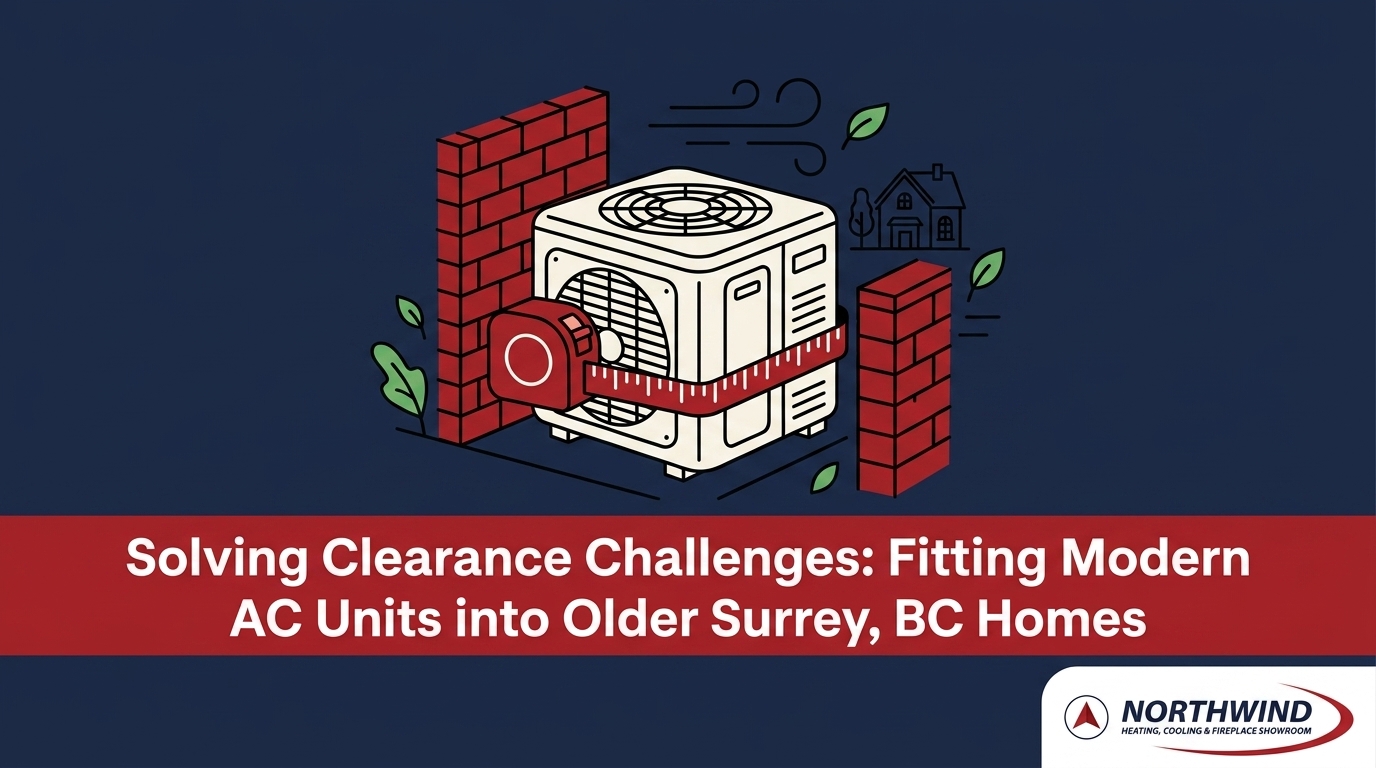
Your home feels like an oven by late afternoon, but every time you look at your narrow side yard or packed utility closet, fitting modern AC units into older Surrey homes with limited clearance seems physically impossible. This is a frustrating architectural puzzle for many residents across the Lower Mainland. Between shrinking lot lines, strict strata regulations, and interior spaces built decades before central air was common, upgrading to a modern, quieter system often feels out of reach. The decision usually comes down to finding equipment that actually fits without requiring a massive structural overhaul of your property.
For tailored advice on navigating these constraints, explore our comprehensive air conditioning solutions or reach out for a professional site assessment.
With Surrey's increasingly warm summers driving up indoor temperatures, relying on open windows and cross-breezes is simply insufficient. Older Surrey BC townhouses and single-family lots were largely designed to retain heat, making them incredibly uncomfortable during July and August heat waves. Homeowners recognize the growing necessity of reliable cooling, but the physical reality of their properties presents significant hurdles.
• Small utility closets: Older homes often feature mechanical rooms barely large enough to hold a standard furnace, leaving no room for a traditional A-coil.
• Strict property line boundaries: Zero-lot-line properties and high-density neighborhoods leave almost no exterior space for bulky condenser units.
• Aesthetic restrictions: Many communities enforce strict visual guidelines that prohibit window units or highly visible exterior equipment.
Fortunately, you no longer need to rely on noisy, inefficient window units to survive the summer. Thanks to modern, low-profile cooling technology, it is entirely possible to retrofit these challenging spaces. Setting the stage for a successful installation requires a deep understanding of both your home's physical limitations and the local regulations that govern mechanical upgrades.
Navigating Surrey Municipal Lot Lines and Strata Clearances
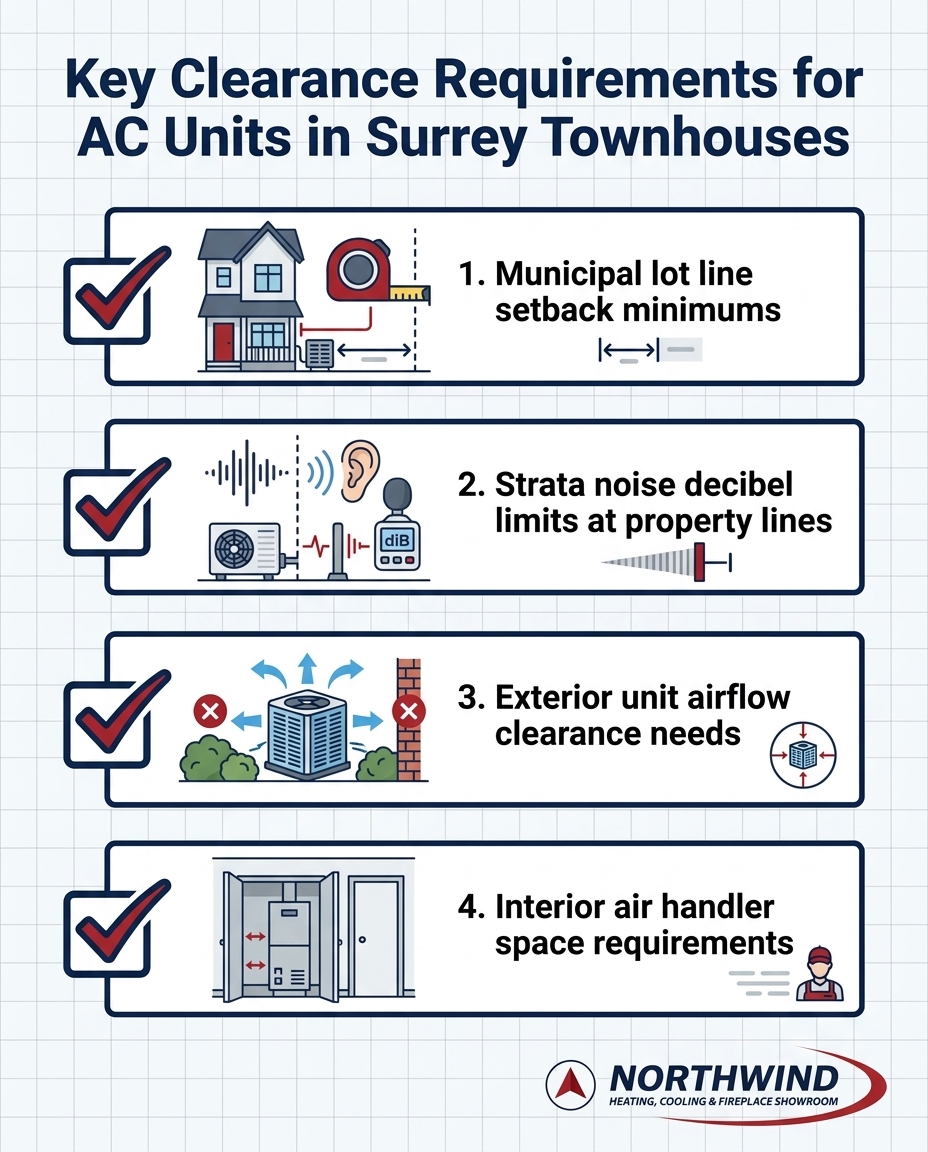
Before you even look at equipment specifications, you must understand the rules dictating where that equipment can sit. The City of Surrey enforces specific zoning bylaws regarding mechanical equipment, and these rules are designed to maintain neighborhood aesthetics and manage noise. Knowing your exact exterior lot line and strata clearance measurements is the mandatory first step in any retrofit project.
Working with a local expert like Northwind Heating means you have a partner who understands how to navigate Surrey strata bylaws and municipal setbacks to prevent costly bylaw infractions. High-density townhouses and zero-lot-line properties present unique challenges because the distance between your home and your neighbor's property is often just a few feet. Traditional air conditioning condensers are large, cube-shaped units that require significant airflow clearance on all sides, making them impossible to install in these narrow corridors legally.
Furthermore, strata rules often impose even stricter clearance and visual requirements than municipal codes. A strata council might dictate exactly where a unit can be placed, what color the line-hide must be, and how much noise the unit is permitted to generate. Proceeding without a professional site assessment to ensure compliance before purchasing equipment is a recipe for disaster, often resulting in homeowners being forced to remove newly installed systems.
Understanding Setback Requirements
A setback is the minimum distance a piece of mechanical equipment must be placed from the property line. This rule exists to ensure adequate access, prevent fire hazards, and reduce noise transmission between neighbors. In many older Surrey neighborhoods, narrow side yards severely limit traditional bulky AC unit installations. If your side yard is only four feet wide, and the city requires a three-foot setback from the property line, you physically cannot install a standard three-foot-wide condenser unit.
Common exterior constraints include:
• Municipal property line setbacks (often requiring 3 to 4 feet of clearance).
• Strata-mandated visual barriers or specific placement zones.
• Manufacturer-required airflow clearances (usually 12 to 24 inches of free space around the unit to prevent overheating).
• Proximity to neighboring windows or patios.
Overcoming Interior Utility Closet and Ductwork Limitations
While exterior lot lines present a major hurdle, the indoor physical constraints typical of older BC homes not originally designed for central air can be equally frustrating. Older Surrey BC townhouses and single-family lots often feature utility closets that were built precisely to the dimensions of a mid-century heating system. When you attempt to add an air conditioning coil to an existing furnace, you suddenly need vertical space that simply does not exist.
The problem: The space limitations of existing utility closets housing older, smaller furnaces make standard retrofits impossible. Additionally, the existing ductwork in these homes is often undersized or routed through tight ceiling and wall cavities, making it difficult to push the volume of cold air required for modern central cooling.
The cause: Homes built before the 1990s in the Lower Mainland rarely prioritized air conditioning. Builders allocated minimal square footage to mechanical rooms to maximize living space, resulting in low ceilings and cramped utility closets.
The solution: Structural modifications can often be avoided with proper system design. Utilizing compact air handlers and strategically rerunning components allows technicians to maximize the existing footprint. One local homeowner faced this exact situation when they needed a new furnace and air conditioner installed. By carefully selecting the right equipment, the installation team fit a new Lennox furnace and air conditioner into the restricted space. The homeowner was incredibly pleased with the exceptionally quiet operation and the even heating and cooling, all achieved without tearing down walls.
Why Compact and Side-Discharge Lennox Units Fit the Bill
When traditional equipment fails to meet your exterior lot line and strata clearance measurements, the solution lies in specialized hardware. Northwind Heating specializes in utilizing specific Lennox compact units as the definitive problem-solver for tight BC lot lines. These systems are engineered specifically for the architectural constraints we see throughout Surrey.
The primary difference between a traditional top-discharge unit and a modern side-discharge design is the airflow path and the physical footprint. Traditional units pull air through the sides and vent it out the top, requiring a large, boxy shape. Side-discharge units, often called "suitcase" units, pull air through the back and vent it out the front. This allows the unit to be incredibly narrow—often less than 18 inches deep.
The specific dimensional advantages of compact and low-profile Lennox AC systems mean they can be installed in narrow side yards, under decks, or mounted on exterior walls while maintaining proper airflow. This compact footprint connects directly to passing strata and municipal clearance inspections, as the unit easily stays within the required setback boundaries.
• Footprint — Traditional Top-Discharge AC: Large, boxy (approx. 30x30 inches) — Lennox Side-Discharge AC: Slim, low-profile (often under 18 inches deep)
• Clearance Needed — Traditional Top-Discharge AC: Requires significant top and side clearance — Lennox Side-Discharge AC: Can be installed closer to walls and under overhangs
• Visual Impact — Traditional Top-Discharge AC: Highly visible, difficult to hide — Lennox Side-Discharge AC: Discreet, easily hidden by landscaping or low fences
• Strata Approval — Traditional Top-Discharge AC: Often rejected due to size and noise — Lennox Side-Discharge AC: Frequently approved due to small size and quiet operation
Ductless Alternatives for Homes Without Existing Infrastructure
Sometimes, central air is structurally impossible due to extreme interior clearance issues or a complete lack of ductwork. For many older Surrey BC townhouses and single-family lots heated by baseboards or radiant heat, trying to retrofit central ductwork would require tearing down ceilings and losing valuable closet space. In these scenarios, ductless technology provides an elegant, highly efficient workaround.
Ductless mini-splits consist of a compact outdoor compressor connected to one or more indoor air-handling units via small refrigerant lines. These exterior lines can be routed discreetly along the siding or hidden within line-hide covers to comply with strict strata aesthetic rules.
The advantages of a ductless approach include:
1. No ductwork required: Eliminates the need for bulky interior duct modifications, saving ceiling height and closet space.
2. Zoning flexibility: You can customize comfort by cooling only the rooms you use, rather than paying to cool empty guest rooms.
3. Compact exterior footprint: The outdoor units are exceptionally slim and can easily meet tight setback requirements.
4. Year-round comfort: Many modern heat pumps offer both cooling and heating in a single system, providing efficient climate control in all seasons.
Another homeowner reached out during a stretch of hot summer days, needing cooling for just a couple of specific rooms in their older property. Instead of attempting a massive central retrofit, the team installed two ductless heat pumps. These units provided instant heat or cooling exactly where it was needed, and the homeowner was thrilled with the stylish indoor units and the immediate climate control.
Meeting Surrey's Noise Control Bylaws with Modern Equipment
Beyond physical space, the secondary regulatory hurdle for any Surrey installation is noise. The City of Surrey Noise Control Bylaw sets strict limits for continuous decibel levels at property boundaries to ensure neighborhood tranquility. When homes are built close together, a noisy air conditioner can easily violate these limits, leading to neighbor complaints and potential fines.
Older AC units frequently violate these modern noise standards, especially in dense townhouse complexes. A compressor turning on can sound like a small jet engine, vibrating through walls and disrupting outdoor living spaces. Knowing your exterior lot line and strata clearance measurements isn't just about physical space; it's about calculating how far the sound will travel before it hits your neighbor's property.
Modern compact Lennox systems feature advanced sound-dampening technology. Heavy-duty compressor blankets, swept-wing fan blades, and variable-capacity operation keep noise levels exceptionally low. Variable-capacity systems are particularly effective because they rarely run at 100% speed. Instead, they run continuously at lower, quieter speeds to maintain the temperature, dramatically reducing the operational decibel level and ensuring you stay well within legal municipal limits.
Frequently Asked Questions About AC Clearance in Surrey
Navigating the specific rules for mechanical installations can be confusing. Before diving into the specific regulations below, if you are looking for ideas on where to place ductless indoor units, you can review our guide on ideal spots for mini-split heat pump installation. Here are the answers to some of the most common questions Surrey residents ask about clearance requirements.
What are the clearance requirements for an AC unit in Surrey?
The exact clearance requirements depend on your specific zoning, but generally, the City of Surrey requires mechanical equipment to be set back a certain distance from the property line. This setback is often between 3 to 4 feet, though zero-lot-line properties have unique exemptions or stricter rules. Additionally, manufacturers require 12 to 24 inches of airflow clearance around the unit itself to prevent the system from suffocating and overheating. Always rely on exterior lot line and strata clearance measurements taken by a professional to ensure full compliance.
Can you install central AC in an older townhouse?
Yes, it is entirely possible to install central AC in an older townhouse, provided you use the right equipment. The key is utilizing compact air handlers that fit into existing small utility closets and selecting low-profile outdoor units that meet strata regulations. You will almost always need formal strata council approval before proceeding, which requires submitting detailed specifications of the proposed system's size and noise rating.
Can you put central air in an old house without ducts?
If your old house lacks ductwork entirely, installing traditional central air is usually cost-prohibitive due to the extensive demolition required. However, you can achieve whole-home cooling using ductless alternatives or high-velocity HVAC systems as workarounds. Ductless mini-splits use small refrigerant lines instead of bulky ducts, making them perfect for retrofitting older homes without sacrificing interior space.
What is a side-discharge air conditioner?
A side-discharge air conditioner is a cooling unit designed to pull air through the back and vent it out the front, rather than venting out the top. This design allows the unit to be incredibly slim, often resembling a large suitcase. These space-saving benefits make them the ideal choice for narrow side yards, patios, or under decks where a traditional top-discharge unit simply will not fit.
Can I install an AC unit directly on my property line?
No, you generally cannot install an AC unit directly on your property line in Surrey. Municipal setback rules and strict noise bylaw restrictions prevent zero-lot-line placement to ensure fire safety, maintenance access, and neighborhood noise control. A professional assessment is required to determine the closest legal placement for your specific property.
Plan Your Surrey AC Retrofit with Confidence
Strict clearances and tight utility closets do not mean you have to sacrifice summer comfort. While older homes present unique architectural challenges, the combination of proper sizing, deep local bylaw knowledge, and modern hardware makes retrofitting entirely possible. Compact and low-profile Lennox AC systems are specifically designed to solve these exact problems, allowing you to enjoy quiet, efficient cooling without violating municipal setbacks or strata rules.
The first step to a cooler home is understanding your exact physical constraints. We encourage you to schedule a professional site assessment so our team can measure your specific clearance needs and recommend the perfect fit. Whether that means a slim side-discharge unit or exploring mini-split systems, clear guidance ensures your new installation is legally compliant, highly efficient, and built to keep you comfortable for years to come.
Other Blog Posts
Customer Testimonials
Go With Experience

I cannot recommend this company enough. We were horribly jerked around by Angels Heating and Cooling. Northwind took the time to answer all our questions, we're professional, timely, affordable and sent a great technician to fix our gas fireplace.
We had a duel fuel system installed by Northwind. Our experience from installation to post installation service has been amazing.
Our fireplace had not been working. This was the only company that was willing to come out. Wes the technician was great. Diagnosed the problem and fixed it. Spoke to Deanna on the phone. She has awesome customer service skills. I would use them again and highly recommend them.
A+ Customer Service! We had a minor issue and they stopped by right away. We've used them on residential and commercial buildings and they are always on top of everything. Thank you to Chris as well!
We purchased and had Nothwind install a Valor gas fireplace for us. They did an excellent job. We did have a problem with the remote control that came with the unit but were very happy with the immediate response and repair from Northwind for warranty work.
I’ve been in the construction business for many years and the Northwind HVAC crew for sure rank up there in the number one spot. Without exception, all the work was carried out swftly, with journeyman style and with a friendly contractor/client relationship.
Home
Blogs