
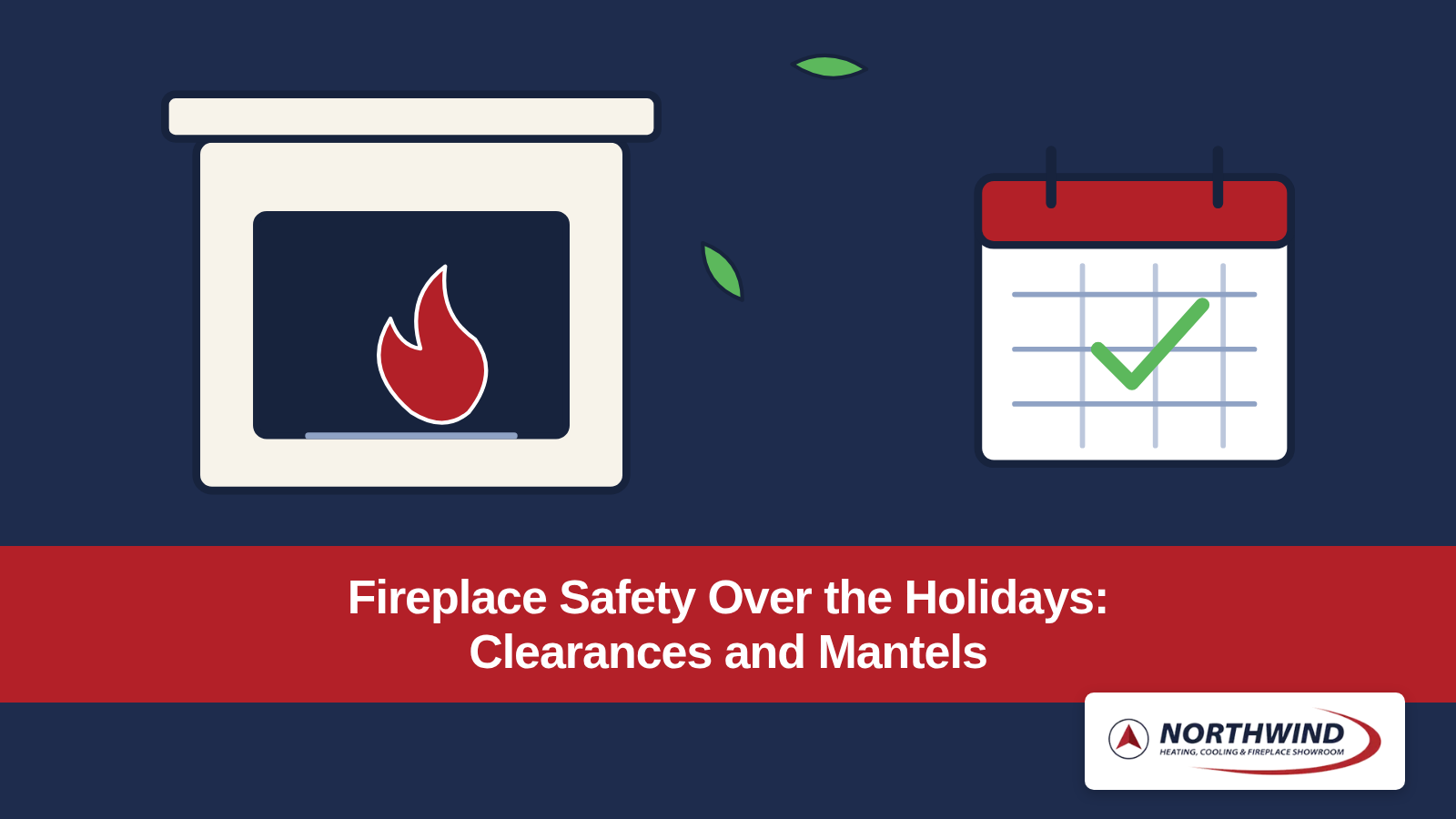
The Time of Year Fireplaces Get Decorated
If you are researching Fireplace Safety Through the Holidays: Clearances, Screens and Mantels, you are thinking about it at exactly the right time. December is when a gas fireplace goes from being an occasional feature to running most evenings, and it is also the month when stockings, garlands and candles arrive on the mantel.
Those two things together are why our team at Northwind Heating, Cooling & Fireplace Showroom raises this every year. The risks are not dramatic or obscure. They are ordinary, well understood, and almost entirely preventable with a few minutes of attention.
This guide covers the clearances that actually matter, the glass temperature issue that surprises most parents, and what to keep off a mantel during the season. If your unit has not been serviced this year, our post on what a proper fireplace service includes is worth reading alongside this.
The Glass Gets Hotter Than People Expect
This is the single most important thing in this article, and it is the one most homeowners underestimate.
Why it is a genuine burn risk
The glass front on a direct-vent gas fireplace is not a decorative panel. It is part of the sealed combustion chamber, and during operation it reaches temperatures capable of causing a serious contact burn almost instantly. Young children are the most frequent casualties, because a glass panel at crawling or toddling height does not look hot and gives no warning.
The other thing people underestimate is cooling time. The glass stays dangerously hot for a substantial period after the fireplace has been switched off — long enough that a child can be burned by a fireplace nobody has used for a while.
What to do about it
• Fit a manufacturer-approved safety screen if your unit does not already have one. Units manufactured in recent years generally include a barrier screen as standard, but older fireplaces often do not, and a retrofit screen is available for most models.
• Use a physical barrier such as a hearth gate where there are crawling children, because a screen reduces the risk rather than eliminating it.
• Treat the cool-down period as part of the risk, not the end of it.
• Tell visitors. Guests over the holidays, particularly ones with small children, have no idea how hot that panel gets.
Clearances That Actually Matter
Every fireplace has clearance requirements set by its manufacturer, and they are specific to the model rather than universal. They are in the installation manual, and if you no longer have it, most manufacturers publish manuals online by model number.
The mantel
Mantel clearance is the one people breach most often, usually with decoration rather than construction. The manufacturer specifies a minimum distance from the top of the firebox opening to the underside of a combustible mantel, and that specification assumes nothing is hanging below it.
Heavy stockings, garland draped along the front edge, or anything suspended from the mantel effectively reduces that clearance. A mantel that is safe when bare can be too close once decorated.
The surround and hearth
Combustible materials to the sides of the opening have their own clearance requirements, and so does the area in front. Rugs, cushions, dog beds and stacks of gifts all end up in this zone in December.
Furniture and soft furnishings
Nothing in the manual covers the armchair someone pulls closer on a cold evening, or the throw blanket that ends up over the back of it. Radiant heat from the glass will affect anything placed directly in front of it for a sustained period.
What Not to Put on the Mantel
A short list, all of them common in December.
• Candles. The mantel is warm during operation, and wax softens and slumps. Candles on a working fireplace mantel tip and drip far more often than people expect.
• Anything flammable hanging down. Stockings and garland are the classic. If it dangles into the space above the opening, it is in the wrong place.
• Real greenery, once it dries. Fresh cut boughs are fine for a while, then become extremely combustible after a couple of weeks in a warm room.
• Electronics or anything sensitive to heat. A mantel above a working fireplace is a hot location, which is worth knowing before mounting a television there.
• Aerosols and spray cans, which occasionally end up on a mantel during decorating and should not stay there.
The Rest of the Holiday Setup
A few things that come up specifically at this time of year.
Christmas trees
A tree positioned near a fireplace dries out considerably faster than one elsewhere in the room, and a dry tree burns with startling speed. Keep it well clear, keep a real tree watered, and check the water daily during the season.
Wrapping paper and packaging
Never burn wrapping paper, boxes or packaging in any fireplace. In a gas unit it does not belong in the firebox at all. Beyond that, coated and printed papers burn hot and fast and can release unpleasant combustion products.
Extension cords and decoration lighting
Seasonal lighting means more extension cords than usual, and they end up routed across hearths and along mantels. Keep them out of the hearth area entirely, and do not run them where they will be walked on or where they will sit against a warm surface.
Carbon monoxide alarms
If you have any fuel-burning appliance — a gas fireplace, a furnace, a gas water heater or a gas range — you should have working carbon monoxide alarms. December is a sensible month to test them, since it is when those appliances are working hardest.
A properly installed and serviced sealed fireplace should not produce carbon monoxide indoors. Alarms are there for when something is not working as it should, which is precisely the situation you cannot detect by other means.
Before the Season Starts
Five minutes of checking is worth doing before the fireplace goes into daily use.
• Look at the glass seal. A gasket that has hardened, shrunk or gone brittle compromises the seal on a sealed appliance.
• Check the vent terminal outside is clear of leaves, nesting material and obstruction.
• Watch the first burn. Note whether it lights promptly and whether the flame looks steady and normal rather than lazy or heavily yellow.
• Notice any smell. A brief dust smell on the first burn of the season is normal. A persistent smell, or any smell of gas, is not.
• Test your CO and smoke alarms.
If anything on that list looks off, sort it before December rather than during it. Availability tightens considerably once the season is underway, which is the same pattern we describe in our post on first cold night failures.
The same clearance thinking applies outdoors, where covered patios and overhead structures cause most of the problems. Our guide to patio heaters and outdoor gas lines covers what suits which space.
Frequently Asked Questions
How hot does gas fireplace glass get?
Hot enough to cause a serious contact burn almost instantly, and it stays dangerously hot for a considerable period after the fireplace is switched off. This is why a manufacturer-approved barrier screen matters, and why a physical barrier such as a hearth gate is worth having in homes with crawling or toddling children.
Can I hang stockings on my fireplace mantel?
Only if they clear the manufacturer's specified minimum distance above the firebox opening, and that specification assumes nothing hanging below the mantel. A mantel that is compliant when bare can be unsafe once stockings or garland hang below it. Check your model's installation manual rather than assuming.
How far should a Christmas tree be from a gas fireplace?
Well clear of both the radiant heat from the glass and the hearth area. A tree near a fireplace dries much faster than one elsewhere in the room, and a dried tree ignites and burns very quickly. Keep a real tree watered and check the reservoir daily through the season.
Do I need a carbon monoxide detector with a gas fireplace?
Yes. Any home with fuel-burning appliances should have working carbon monoxide alarms. A correctly installed and maintained sealed fireplace should not put carbon monoxide into your living space, but alarms exist for the situation where something is not working correctly, which you cannot otherwise detect.
Can I burn wrapping paper in my fireplace?
No. In a gas fireplace nothing should be burned in the firebox at all. Even in a wood-burning appliance, coated and printed papers burn hot and fast and can release unpleasant combustion products, which is why it is a bad idea regardless of the appliance.
Is it safe to mount a TV above a gas fireplace?
It depends on the specific unit and how much heat the wall above it sees, which varies considerably between models. The mantel area above a working fireplace is a warm location, and heat is not good for electronics over time. Check the fireplace manufacturer's guidance for the model before committing to the installation.
Enjoying It Safely
None of this is a reason to use your fireplace less. A properly installed, serviced gas fireplace is a safe and efficient way to heat the room you actually spend the evening in, which is exactly what you want in December.
Northwind Heating, Cooling & Fireplace Showroom has been installing and servicing fireplaces across Surrey, Langley, Delta, White Rock and the wider Lower Mainland since 1989. If your unit needs a service before the season, or if you would like a barrier screen fitted to an older model, get in touch — and our fireplace showroom is there if you are considering an upgrade.
Other Blog Posts
Customer Testimonials
Go With Experience

I cannot recommend this company enough. We were horribly jerked around by Angels Heating and Cooling. Northwind took the time to answer all our questions, we're professional, timely, affordable and sent a great technician to fix our gas fireplace.
We had a duel fuel system installed by Northwind. Our experience from installation to post installation service has been amazing.
Our fireplace had not been working. This was the only company that was willing to come out. Wes the technician was great. Diagnosed the problem and fixed it. Spoke to Deanna on the phone. She has awesome customer service skills. I would use them again and highly recommend them.
A+ Customer Service! We had a minor issue and they stopped by right away. We've used them on residential and commercial buildings and they are always on top of everything. Thank you to Chris as well!
We purchased and had Nothwind install a Valor gas fireplace for us. They did an excellent job. We did have a problem with the remote control that came with the unit but were very happy with the immediate response and repair from Northwind for warranty work.
I’ve been in the construction business for many years and the Northwind HVAC crew for sure rank up there in the number one spot. Without exception, all the work was carried out swftly, with journeyman style and with a friendly contractor/client relationship.
Home
Blogs